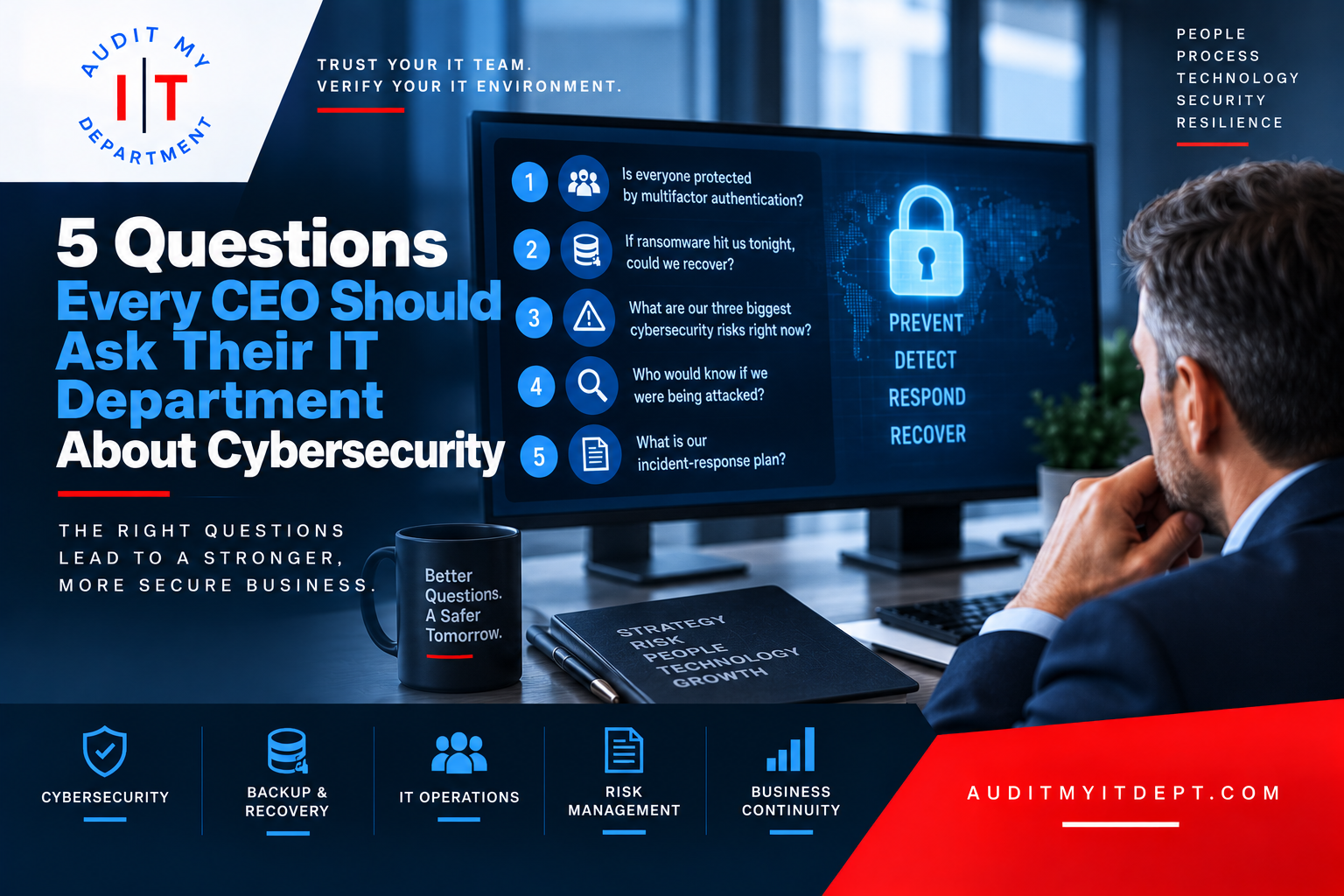
5 Questions Every CEO Should Ask Their IT Department About Cybersecurity
Cybersecurity conversations between executives and IT departments can become technical very quickly.
Firewalls. Endpoint detection. Conditional access. Zero trust. SIEM. Vulnerability management. Encryption. DNS filtering.
Those technologies may all be important.
But a CEO shouldn’t need a cybersecurity certification to determine whether the company is taking reasonable steps to protect itself.
Leadership’s responsibility isn’t to configure security systems.
It’s to understand the organization’s risk, preparedness, and ability to recover.
And you can learn a surprising amount by asking your IT department five straightforward questions.
Question #1: Is Everyone Protected by Multifactor Authentication?
Start with one of the most fundamental cybersecurity controls:
“Does every account that should have multifactor authentication actually have it?”
Multifactor authentication, or MFA, adds another layer of verification beyond a password.
If an attacker obtains an employee’s password, MFA can make it significantly more difficult to use that credential to access the account.
Many organizations will answer:
“Yes, we use MFA.”
But leadership should go one step further.
Ask whether MFA applies to:
- All employees
- Remote access
- Microsoft 365
- Administrative accounts
- Cloud applications
- Outside vendors
- Privileged systems
The distinction matters.
An organization can technically have MFA enabled while still maintaining exceptions that create unnecessary exposure.
Administrative Accounts Deserve Special Attention
Administrative accounts are particularly important because they can have enormous control over an organization’s technology.
An attacker who compromises an ordinary employee account may gain access to that employee’s information.
An attacker who compromises a highly privileged administrator may gain access to much more.
Leadership should therefore ask:
“Are our most powerful accounts receiving our strongest protections?”
The answer should be clear.
Question #2: If Ransomware Hit Us Tonight, Could We Recover?
This question moves cybersecurity from prevention to resilience.
“If ransomware encrypted our systems tonight, how would we recover?”
Every organization should assume that preventive controls can potentially fail.
That’s why backup and disaster recovery are also cybersecurity issues.
Ask your IT team:
- What systems are backed up?
- How often?
- Where are backups stored?
- Can attackers access the backups from the production network?
- Are any backup copies isolated or immutable?
- When was the last successful restore test?
- How long would recovery take?
- Which systems would be restored first?
A statement such as:
“Our backups run every night.”
isn’t a complete answer.
The real question is:
Can the organization recover from them?
Question #3: What Are Our Three Biggest Cybersecurity Risks Right Now?
This may be the most revealing question on the list.
Ask your IT leader:
“If you had to identify our three biggest cybersecurity risks today, what would they be?”
A mature cybersecurity program should be able to acknowledge weaknesses.
Maybe the answer is:
- Aging infrastructure
- Legacy software
- Insufficient employee training
- Weak backup isolation
- Excessive administrator privileges
- Incomplete MFA deployment
- Poor documentation
- Limited security monitoring
- Unpatched applications
- Lack of incident-response planning
The exact answer will vary.
What matters is whether the IT department can identify the risks and explain what is being done about them.
“We Don’t Have Any Major Risks” Should Lead to More Questions
No organization has zero cybersecurity risk.
Technology changes too quickly.
New vulnerabilities appear.
Employees make mistakes.
Attack techniques evolve.
Business requirements change.
A strong IT department doesn’t need to claim the environment is perfect.
Instead, it should be able to say:
“Here are our most significant risks, here’s how we’re reducing them, and here’s where we still need improvement.”
That demonstrates awareness and planning.
Question #4: Who Would Know If We Were Being Attacked?
Many cybersecurity tools generate alerts.
But an alert has little value if nobody is monitoring it.
Leadership should ask:
“Who is responsible for detecting and responding to suspicious activity?”
Depending on the organization, this could be:
- Internal IT
- An MSP
- A managed security provider
- A security operations center
- A combination of several teams
Then ask:
What happens when an alert occurs?
Who receives it?
Who investigates it?
Who determines whether it’s serious?
Who can isolate a compromised computer?
Who contacts leadership?
Who contacts cyber insurance?
What happens after business hours?
These operational questions matter as much as the security software itself.
Buying Security Software Is Not a Cybersecurity Strategy
Organizations sometimes accumulate security products without establishing clear operational responsibility.
They may have:
- Antivirus
- Endpoint detection
- Email filtering
- Firewalls
- MFA
- Backup systems
- Security awareness platforms
All of those tools can be valuable.
But tools must be:
Configured
Monitored
Maintained
Updated
Responded to
Cybersecurity isn’t simply a collection of software licenses.
It’s an ongoing process.
Question #5: What Is Our Incident-Response Plan?
Now ask the question many organizations avoid:
“What exactly happens if we have a serious cybersecurity incident?”
Suppose tomorrow morning your organization discovers ransomware spreading across the network.
Who makes the first call?
Does IT immediately shut systems down?
Who contacts leadership?
Who contacts the cyber insurance carrier?
Who contacts legal counsel?
How will employees communicate if email is unavailable?
Who determines whether sensitive information was accessed?
Who communicates with customers if necessary?
Where are emergency contact numbers stored?
These decisions shouldn’t be invented while an attack is happening.
The CEO Doesn’t Need to Run the Incident
Leadership shouldn’t be diagnosing malware or examining security logs.
But executives need to understand the business response.
Cyber incidents can quickly involve:
- Operations
- Legal
- Insurance
- Finance
- Communications
- Human resources
- Customers
- Vendors
- Law enforcement
At that point, the event is no longer simply an IT problem.
It’s a business crisis.
The organization should have at least a basic plan for coordinating the response.
Ask for Evidence, Not Just Reassurance
There is a difference between:
“Yes, we’re protected.”
and:
“Here is how we’re protected.”
Leadership doesn’t need hundreds of pages of technical evidence.
But reasonable verification could include:
- MFA coverage
- Patch compliance
- Security awareness participation
- Endpoint protection status
- Backup test results
- Security incidents
- Vulnerability findings
- Administrative account reviews
- Technology risks
- Remediation progress
A simple executive cybersecurity dashboard can sometimes provide tremendous value.
The objective is visibility.
Cybersecurity Should Be Discussed in Business Terms
Executives and IT professionals sometimes struggle to communicate because they approach risk differently.
IT might say:
“We have several unsupported endpoints.”
Leadership may not understand the significance.
A better explanation is:
“Several company computers no longer receive security updates, increasing the likelihood that known vulnerabilities could be exploited.”
IT might say:
“Our RTO isn’t aligned with the current backup architecture.”
Leadership needs:
“Our current recovery process could leave the business without this system for approximately two days.”
Good cybersecurity communication translates technical findings into:
Risk, impact, priority, and action.
Don’t Ask: “Are We Secure?”
There is another important lesson for leadership.
Avoid asking:
“Are we secure?”
It’s almost impossible to answer meaningfully.
No organization can guarantee it will never experience a cybersecurity incident.
Instead ask:
What are our biggest risks?
What are we doing about them?
How would we detect an attack?
How would we respond?
How would we recover?
Those questions produce far more useful conversations.
Your IT Department May Need Leadership’s Help
Sometimes cybersecurity weaknesses aren’t caused by IT.
Your IT department may have been recommending improvements that leadership hasn’t approved.
Perhaps IT has requested:
- Better backup protection
- Additional security monitoring
- Replacement of old computers
- Employee security training
- A firewall upgrade
- Additional staffing
- Stronger Microsoft 365 licensing
- An independent security assessment
Those recommendations may have been delayed because of budget or competing priorities.
Asking these five questions gives IT an opportunity to explain where leadership support is needed.
Cybersecurity is a shared business responsibility.
Independent Verification Adds Another Layer
Even organizations with strong IT teams can benefit from an outside perspective.
An independent IT assessment can help verify questions such as:
- Is MFA consistently implemented?
- Are privileged accounts appropriately protected?
- Are backups isolated and recoverable?
- Are systems patched and supported?
- Is security software being monitored?
- Are former accounts properly disabled?
- Is cybersecurity documented?
- Does an incident-response process exist?
- Does leadership understand the organization’s primary technology risks?
The goal isn’t to replace the IT department.
It’s to give leadership another source of information.
Five Questions. A Much Clearer Picture.
At your next leadership or IT meeting, ask:
1. Is everyone who should be protected by MFA actually protected?
2. If ransomware hit us tonight, could we recover?
3. What are our three biggest cybersecurity risks right now?
4. Who would know if we were being attacked?
5. What is our incident-response plan?
You don’t need technical answers filled with acronyms.
You need answers you can understand.
If your IT team can clearly explain each area, that’s a positive sign.
If the answers are uncertain, inconsistent, or impossible to verify, you’ve identified areas worth examining.
Trust Your IT Team. Verify Your Cybersecurity.
Your IT department may be doing an outstanding job protecting the organization.
That’s exactly what you want an independent review to confirm.
Cybersecurity isn’t about creating fear.
It’s about understanding risk and making informed decisions before an incident makes those decisions for you.
Leadership doesn’t need to know everything about cybersecurity. It needs to know the right questions to ask.
Would You Like Independent Answers?
Audit My IT Department helps business owners and leadership teams independently evaluate cybersecurity as part of their overall technology environment.
We review cybersecurity, backup and disaster recovery, Microsoft 365, IT operations, documentation, infrastructure, and technology strategy.
The objective is simple:
Give leadership a clearer picture of what’s working, where risk exists, and what should happen next.
REQUEST AN IT AUDIT
847-281-5953
AuditMyITDept.com