Ransomware attacks, stolen credentials, phishing, business email compromise, data breaches, and other threats have pushed security into the boardroom.
That’s a good thing.
Leadership should understand cybersecurity risk.
But it has also created a common misconception:
Cybersecurity health and IT health are not the same thing.
A business could have strong cybersecurity controls and still have serious technology problems.
Its backups might not be recoverable.
Its IT environment might be poorly documented.
Critical equipment might be approaching end of life.
The company might depend entirely on one IT employee.
Administrative access might not be properly controlled.
Technology spending might be poorly understood.
There might be no disaster-recovery plan.
Conversely, a company may have well-managed IT operations while still having cybersecurity weaknesses that require attention.
That’s why understanding the difference between an IT audit and a cybersecurity assessment matters.
They overlap.
But they answer different questions.
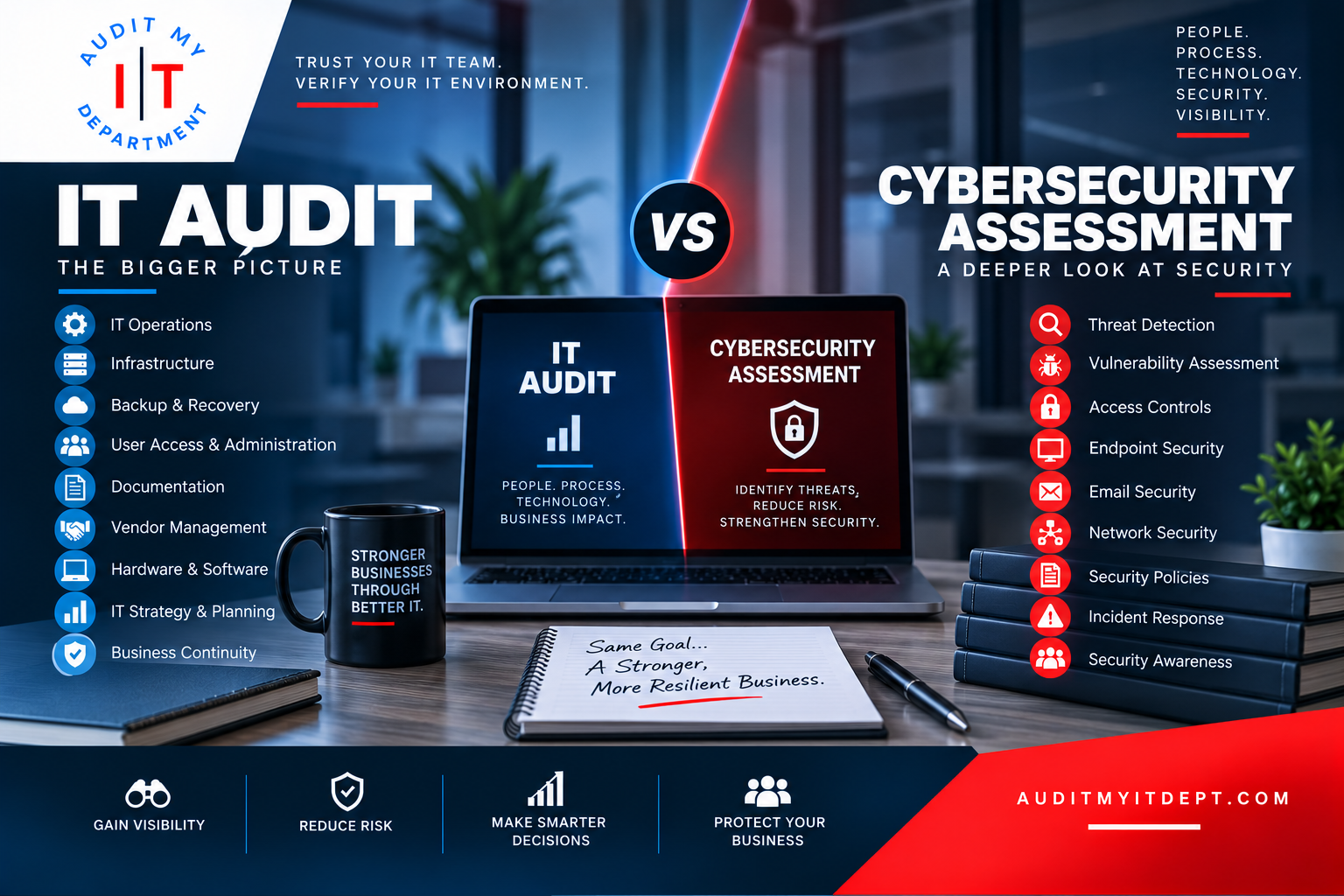
What Is an IT Audit?
In the context of an independent technology assessment, an IT audit examines the broader health and management of an organization’s technology environment.
The fundamental question is:
“Is our IT environment being appropriately managed for the needs and risks of our business?”
Cybersecurity is an important part of that review.
But it isn’t the only part.
An IT audit may examine areas such as:
- Cybersecurity
- Backup and disaster recovery
- Microsoft 365
- User accounts and access
- Administrative privileges
- Employee onboarding and offboarding
- IT documentation
- Network infrastructure
- Hardware lifecycle
- Software licensing
- Patch management
- Help desk operations
- Vendor management
- Technology ownership
- Business continuity
- IT spending
- Technology strategy
- IT department or MSP performance
The objective is to give leadership a broader picture of how technology is being managed.
What Is a Cybersecurity Assessment?
A cybersecurity assessment focuses specifically on the organization’s security posture and exposure to cyber risk.
Its fundamental question is closer to:
“How well are we protecting our systems, accounts, information, and users from cyber threats?”
Depending on the scope and methodology, a cybersecurity assessment may examine areas such as:
- Multifactor authentication
- Endpoint protection
- Email security
- Firewalls
- Administrative privileges
- Identity protection
- Patch management
- Vulnerability management
- Remote access
- Security monitoring
- Password practices
- Employee security awareness
- Incident response
- Data protection
- Security policies
- Account management
More specialized security engagements may go considerably deeper.
For example, vulnerability assessments may look for technical vulnerabilities across systems.
Penetration testing may attempt to exploit certain weaknesses under an agreed scope.
Those are valuable services—but they’re not necessarily the same thing as a broad IT audit.
The Simplest Way to Understand the Difference
Think about it this way:
A cybersecurity assessment asks:
“How well are we protected?”
An IT audit asks:
“How well is our technology environment being managed overall?”
Security is part of technology management.
But technology management includes much more than security.
Example: Your Backups
Backups illustrate the overlap very well.
From a cybersecurity perspective, an assessor may ask:
- Are backups protected from ransomware?
- Can attackers access or delete them?
- Are backup credentials appropriately protected?
- Are backup copies isolated?
Those are important security questions.
An IT audit may ask those questions too.
But it may also ask:
- What is being backed up?
- What isn’t being backed up?
- How frequently do backups occur?
- How long is data retained?
- Who monitors failed jobs?
- When was recovery last tested?
- How long would recovery take?
- Does recovery meet business expectations?
The cybersecurity review focuses heavily on protecting the backup environment.
The broader IT review also focuses on whether the backup strategy actually supports the business.
Example: Microsoft 365
The same distinction appears in Microsoft 365.
A cybersecurity assessment may review:
- MFA
- Administrative accounts
- Identity security
- Email protection
- Suspicious sign-ins
- External sharing
- Security policies
- Account compromise risks
An IT audit may include those areas while also considering:
- Licensing
- Account management
- Former employees
- Administrative ownership
- SharePoint and OneDrive usage
- Vendor access
- Support processes
- Documentation
- Retention and recovery considerations
- Whether the environment is being managed consistently
Again, there is overlap.
But the perspective is broader.
Example: Your IT Department
This is where the distinction becomes particularly important.
A cybersecurity assessment may determine that your security tools and controls need improvement.
But it may not answer questions such as:
Is the IT department properly documented?
Does the business depend too heavily on one IT person?
Are support requests being managed effectively?
Are technology projects being planned?
Does leadership understand upcoming IT expenses?
Are vendor relationships properly controlled?
Is aging equipment being replaced strategically?
Is the company receiving the services included in its MSP agreement?
Those are IT governance and operational questions.
They’re important even when cybersecurity is strong.
Cybersecurity Is One Piece of IT Risk
Cyberattacks receive enormous attention because the consequences can be severe.
But businesses face other technology risks too.
Consider what happens if:
- A critical server fails
- The internet connection goes down
- The primary IT employee resigns
- A cloud application becomes unavailable
- The company loses control of its domain
- An important software vendor disappears
- A backup cannot be restored
- Critical documentation doesn’t exist
- A major piece of hardware reaches end of life
- A former employee still controls an important account
- An IT provider relationship ends unexpectedly
None of these situations requires a hacker.
Yet each could disrupt the business.
That’s why leadership should think about IT risk, not cybersecurity risk alone.
What About a Vulnerability Assessment?
Another term businesses encounter is vulnerability assessment.
A vulnerability assessment is generally more technically focused.
Its purpose is to identify potential weaknesses in systems, devices, applications, or configurations.
It may identify issues such as:
- Missing security patches
- Outdated software
- Exposed services
- Configuration weaknesses
- Known vulnerabilities
- Unsupported systems
This can be an important component of a cybersecurity program.
But it doesn’t necessarily tell leadership whether:
- Backups are recoverable
- IT documentation is adequate
- Technology spending is appropriate
- IT support is effective
- Vendor relationships are properly managed
- Technology strategy aligns with the business
A vulnerability scan can tell you a great deal about vulnerabilities.
It cannot tell you everything about the health of your IT operation.
What About Penetration Testing?
Penetration testing goes another step.
Under an agreed scope, security professionals attempt to determine whether certain weaknesses can actually be exploited.
Penetration testing can provide valuable insight into technical security exposure.
But again:
A penetration test is not a complete IT audit.
A company could perform well during a penetration test and still have significant operational IT risks.
Or an IT audit could find an otherwise well-managed environment that would benefit from deeper penetration testing.
Different tools answer different questions.
Which One Does Your Business Need?
Potentially both.
It depends on what leadership is trying to learn.
If the primary concern is:
“Could attackers compromise our systems?”
A cybersecurity-focused assessment may be appropriate.
If the concern is:
“How healthy is our entire IT operation?”
A broader IT audit may be more appropriate.
If leadership wants a complete picture, the organization may benefit from both broad IT oversight and deeper cybersecurity testing where warranted.
The key is understanding the scope before the engagement begins.
When a Cybersecurity Assessment Makes Sense
A cybersecurity-focused assessment may be especially valuable when:
- Cybersecurity is the primary concern
- Customers require security validation
- Cyber insurance raises questions
- The organization has experienced an incident
- Leadership wants deeper security analysis
- New security controls have been implemented
- Regulatory or contractual requirements exist
- The organization wants vulnerability testing
- A penetration test is appropriate
The scope should match the organization’s objectives.
When a Broader IT Audit Makes Sense
An independent IT audit may be particularly useful when:
- Leadership lacks visibility into IT
- The organization hasn’t had an independent review
- The company relies heavily on one IT person
- A new executive has joined the organization
- The business is growing rapidly
- Technology expenses are increasing
- An MSP manages most technology
- Documentation is uncertain
- Backups haven’t been independently reviewed
- Major technology investments are approaching
- The company is considering changing IT providers
- Leadership simply wants a second opinion
You don’t need to wait for a problem.
In fact, the best time to understand your IT environment is before something goes wrong.
Don’t Ask for an “IT Audit” Without Understanding the Scope
This is one of the most important lessons for business owners.
The term IT audit can mean different things to different organizations.
One provider may conduct a cybersecurity scan and call it an IT audit.
Another may perform a compliance review.
Another may examine financial controls around information systems.
Another may conduct a broad technology assessment.
Before engaging anyone, ask:
“Exactly what will you review?”
Then ask:
“What will we receive at the end?”
Those two questions can prevent a great deal of confusion.
Leadership Needs More Than a Technical Report
Whether the organization conducts a cybersecurity assessment or a broader IT audit, the results should ultimately help leadership make decisions.
A report containing hundreds of technical findings may be useful to IT professionals.
But business leadership also needs to understand:
- What is most important?
- What represents the greatest business risk?
- What is working well?
- What needs improvement?
- What should be addressed first?
- What requires budget?
- What can wait?
- Who should be responsible?
- What should leadership monitor going forward?
Technical findings become much more valuable when they’re connected to business impact.
An IT Audit Shouldn’t Replace Specialized Security Testing
A broad IT assessment has limits.
If an assessment identifies potential security concerns, deeper technical work may be appropriate.
That could include:
- Vulnerability scanning
- Penetration testing
- Microsoft 365 security reviews
- Firewall assessments
- Incident-response planning
- Compliance assessments
- Specialized security testing
An independent IT audit should help leadership identify where deeper analysis may be warranted.
It shouldn’t pretend that one assessment replaces every specialized cybersecurity discipline.
And Cybersecurity Testing Shouldn’t Replace IT Oversight
The reverse is also true.
Passing a security assessment doesn’t automatically mean the entire IT environment is healthy.
Your organization still needs:
- Reliable backups
- Good documentation
- Appropriate technology ownership
- Effective support
- Hardware lifecycle planning
- Vendor management
- Business continuity
- Strategic planning
- Operational accountability
Security matters enormously.
But the business depends on technology for more than security.
A Simple Question for Leadership
Instead of beginning with:
“Do we need an IT audit or a cybersecurity assessment?”
Start with:
“What are we trying to understand?”
If you want to understand cyber exposure, focus deeply on cybersecurity.
If you want to understand the overall health of IT, take a broader view.
If both matter, build an assessment strategy that addresses both.
The terminology matters less than making sure the scope answers the questions leadership actually has.
Trust Your IT Team. Verify Your IT Environment.
Your IT department may have implemented strong cybersecurity controls.
Your MSP may be managing the environment exceptionally well.
Your backups may be reliable.
Your documentation may be complete.
Your infrastructure may be healthy.
That’s exactly what an independent assessment can help confirm.
And if weaknesses exist, leadership can address them based on evidence rather than assumptions.
Cybersecurity asks whether you’re protected.
An IT audit asks whether your technology environment is healthy.
A well-managed business should care about both.
Get an Independent View of Your IT
Audit My IT Department provides independent IT assessments designed to give business owners and leadership teams greater visibility into their technology environment.
We review areas including cybersecurity, backup and disaster recovery, Microsoft 365, access control, infrastructure, documentation, IT operations, business continuity, and technology strategy.
Our objective isn’t to manufacture problems or automatically replace your existing IT team.
It’s to provide clarity.
Trust your IT team. Verify your IT environment.
REQUEST AN IT AUDIT
847-281-5953
AuditMyITDept.com