Category: Cybersecurity
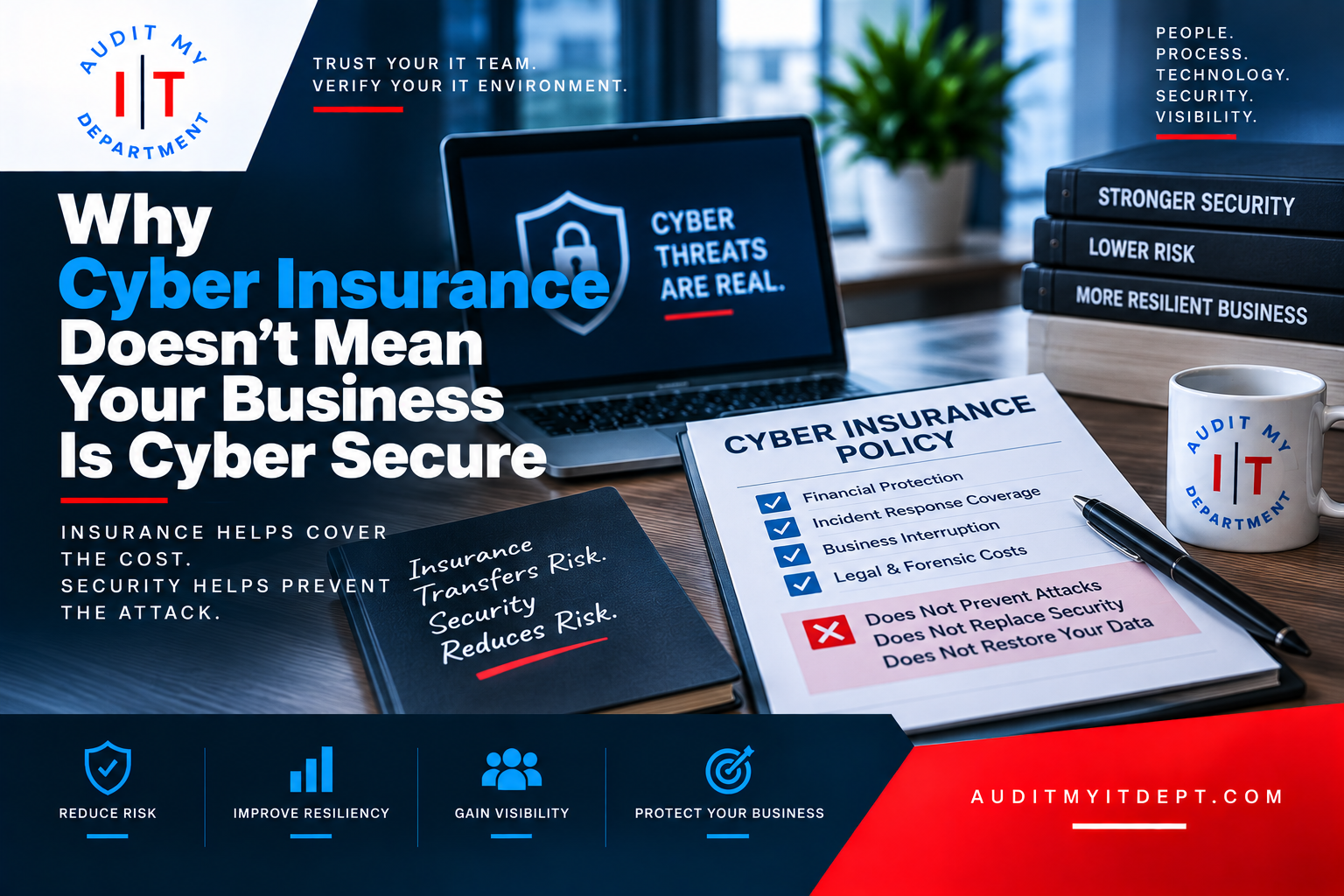
Why Cyber Insurance Doesn’t Mean Your Business Is Cyber Secure
More businesses are purchasing cyber insurance.
That’s a positive development.
A serious cybersecurity incident can create significant financial consequences, including:
- Business interruption
- Recovery expenses
- Legal costs
- Incident-response expenses
- Data-restoration costs
- Customer notification
- Forensic investigations
- Potential liability
Cyber insurance can play an important role in an organization’s overall risk-management strategy.
But there’s a dangerous assumption business leaders should avoid:
“We have cyber insurance, so we’re protected.”
Insurance and cybersecurity serve two very different purposes.
Cybersecurity attempts to reduce the likelihood and impact of an incident.
Insurance may help address certain financial consequences after a covered event occurs, subject to the policy’s terms, conditions, exclusions, limits, and circumstances.
You may need both.
But one does not replace the other.
Insurance Doesn’t Stop an Attack
Imagine an attacker steals an employee’s Microsoft 365 credentials.
Cyber insurance doesn’t stop the login.
Imagine ransomware begins encrypting company systems.
Cyber insurance doesn’t isolate the infected computer.
Imagine an employee approves a fraudulent MFA request.
Cyber insurance doesn’t automatically block the account.
Imagine a malicious email reaches an employee’s inbox.
Cyber insurance doesn’t determine whether the employee clicks the link.
That’s what cybersecurity controls, processes, technology, monitoring, and employee awareness are designed to address.
Insurance may help manage financial risk.
Security helps manage technology risk.
Those are related—but fundamentally different—functions.
The Fire Insurance Comparison
Think about your building.
A company may carry property insurance.
That doesn’t mean it removes:
- Smoke detectors
- Fire alarms
- Fire extinguishers
- Sprinklers
- Emergency exits
- Electrical maintenance
- Fire-safety procedures
Why?
Because the objective isn’t simply to receive financial assistance after a fire.
The objective is to prevent the fire where possible, limit the damage if one occurs, protect people, and recover afterward.
Cybersecurity should be approached similarly.
Insurance is one layer.
It shouldn’t be the entire strategy.
Cyber Insurance Applications Ask Important Questions
Businesses applying for cyber coverage may be asked about their security practices.
The exact questions vary by insurer, policy, business, and risk profile, but organizations may encounter questions involving areas such as:
- Multifactor authentication
- Backups
- Endpoint protection
- Security monitoring
- Employee training
- Email security
- Patch management
- Administrative access
- Remote access
- Incident response
- Data protection
These questions should not simply be viewed as paperwork necessary to obtain coverage.
They can reveal something important:
Insurers care about how your technology is actually protected.
And business leadership should too.
Do You Know Whether the Answers Are Accurate?
Here’s where things become interesting.
Who completes your cyber insurance application?
The owner?
CFO?
Office manager?
Insurance broker?
IT department?
Managed service provider?
Perhaps several people contribute.
Now ask:
How does leadership know the answers are accurate?
Suppose the application asks whether multifactor authentication is deployed.
Someone checks Yes.
But does that mean:
- Every employee?
- Microsoft 365 only?
- Administrative accounts?
- VPN access?
- Remote access?
- Every critical cloud application?
The difference matters.
A simple yes-or-no answer can hide a much more complicated technical reality.
“We Have MFA” Isn’t Enough Information
Multifactor authentication is a perfect example.
Leadership asks:
“Do we have MFA?”
IT answers:
“Yes.”
That sounds reassuring.
But a better question is:
“Which important accounts are not protected by MFA?”
Perhaps all normal Microsoft 365 users have MFA.
But an old administrator account doesn’t.
Perhaps employees use MFA for email but not remote access.
Perhaps a critical cloud application doesn’t support it.
Perhaps exceptions exist for technical reasons.
The point isn’t that every exception automatically means the environment is insecure.
The point is that leadership should understand what the answer actually means.
The Same Problem Exists With Backups
An insurance questionnaire may ask whether the organization maintains backups.
The company answers yes.
But consider how many questions exist behind that single answer:
- What is backed up?
- How frequently?
- Where are backups stored?
- How long are they retained?
- Who monitors failures?
- Are backup credentials protected?
- Can ransomware reach the backups?
- When was recovery last tested?
- How long would recovery take?
A company can truthfully say:
“Yes, we have backups.”
And still discover during an emergency that recovery is much more difficult than expected.
Having backups and being recoverable aren’t necessarily the same thing.
Your Policy Is Not an Incident-Response Plan
Another important distinction:
Your cyber insurance policy shouldn’t be confused with your cybersecurity incident-response plan.
If ransomware hits tomorrow morning, your organization may need to know:
- Who identifies the incident?
- Who isolates affected systems?
- Who contacts leadership?
- Who contacts the insurance carrier or broker?
- Who contacts legal counsel when appropriate?
- Who coordinates technical response?
- Who communicates with employees?
- How are critical systems recovered?
- Who makes business decisions?
- What documentation needs to be preserved?
During a serious incident, confusion costs time.
And during a cybersecurity event, time can matter enormously.
Your organization should understand its response process before an incident occurs.
Do You Know Who to Call?
Ask leadership this simple question:
“If we discovered ransomware at 7:00 tomorrow morning, who is the first person we call?”
Then ask:
Who’s second?
Your IT provider?
Insurance broker?
Carrier?
Incident-response company?
Attorney?
Internal executive?
The exact sequence depends on the organization’s plan and circumstances.
What’s important is that the company doesn’t begin figuring everything out during the emergency.
Key contacts and escalation procedures should be documented and accessible.
Cyber Insurance Doesn’t Restore Your Data
Insurance may provide financial resources associated with a covered incident.
But your business still needs a way to restore its systems and data.
That requires:
- Backups
- Recovery procedures
- Technical expertise
- Documentation
- Appropriate access
- Recovery priorities
- Testing
Suppose an insurer helps cover eligible recovery expenses.
That’s useful.
But if the organization doesn’t have usable backups of critical data, money alone doesn’t magically recreate the information.
Recovery capability still matters.
Insurance Doesn’t Know Your Environment
Your insurance company isn’t managing your network every day.
It doesn’t necessarily know:
- Which server is approaching failure
- Which employee still has unnecessary administrative access
- Which former employee account wasn’t disabled
- Which backup hasn’t been tested
- Which firewall is nearing replacement
- Which cloud application lacks MFA
- Which system isn’t properly documented
Those are IT-management issues.
They need to be identified and addressed within the technology environment itself.
What About Your Managed IT Provider?
Many businesses rely on an MSP to manage cybersecurity.
That’s perfectly reasonable.
A good MSP can provide tremendous value.
But leadership should still understand what is being managed.
Ask your provider:
“What cybersecurity controls do we currently have?”
Then:
“What significant security risks remain?”
And:
“Are there improvements you’ve recommended that we haven’t implemented?”
That last question is especially important.
Sometimes leadership assumes IT has everything covered.
Meanwhile, the IT provider may have been recommending a security improvement for months.
The recommendation may have been delayed because of:
- Cost
- Operational concerns
- Licensing
- Employee resistance
- Competing priorities
An independent review can help surface those situations.
Cybersecurity Is a Shared Responsibility
It’s tempting for leadership to think:
“Cybersecurity is IT’s job.”
IT absolutely plays a major role.
But leadership makes decisions that affect cybersecurity.
Leadership approves:
- Budgets
- Staffing
- Security tools
- Insurance
- Policies
- Technology replacements
- Training
- Risk acceptance
IT can identify a risk.
But leadership may ultimately decide whether the organization spends the money necessary to address it.
That’s why cybersecurity needs communication between IT and business leadership.
Ask About Your Biggest Remaining Risks
No organization eliminates all cybersecurity risk.
That’s unrealistic.
Instead, ask:
“What are our three biggest remaining cybersecurity risks?”
This question is powerful because it acknowledges reality.
Your IT department may have implemented:
- MFA
- Endpoint security
- Backups
- Email filtering
- Firewalls
- Security monitoring
Excellent.
Now what remains?
Perhaps:
- Legacy software
- Employee phishing risk
- Weak disaster recovery
- Excessive administrative access
- A critical application without MFA
- Incomplete security monitoring
- Poor documentation
Leadership needs to know where the remaining risk exists.
Insurance Should Be Part of a Layered Strategy
Think about cybersecurity as layers.
Layer 1 — Prevention
Controls designed to reduce the likelihood of compromise.
Examples may include:
- MFA
- Email security
- Endpoint protection
- Patching
- Firewalls
- Employee awareness
Layer 2 — Detection
Controls designed to identify suspicious activity.
Examples may include:
- Security monitoring
- Endpoint detection
- Identity monitoring
- Alerting
Layer 3 — Response
Processes for reacting when something happens.
Examples may include:
- Incident-response procedures
- Escalation
- Containment
- Investigation
Layer 4 — Recovery
Capabilities designed to restore operations.
Examples include:
- Backups
- Disaster recovery
- Business continuity
- Documentation
Layer 5 — Financial Risk Transfer
That’s where cyber insurance can play a role.
Insurance belongs in the strategy.
It isn’t the strategy.
When Was Your Cybersecurity Last Independently Reviewed?
Your IT provider may be doing an excellent job.
Your internal IT department may have strong security practices.
Your insurance broker may have helped you obtain appropriate coverage.
But each party has a different role.
An independent technology assessment can help leadership verify whether the controls it believes exist are actually present and being appropriately managed.
That may include reviewing areas such as:
- MFA
- Administrative access
- Former employee accounts
- Backups
- Recovery testing
- Security tools
- Patch management
- Microsoft 365
- Documentation
- Incident-response readiness
The objective isn’t to replace your insurance broker.
It isn’t to replace your IT provider.
It’s to provide another layer of visibility.
Before Your Next Cyber Insurance Renewal
Instead of waiting until the renewal questionnaire arrives, consider reviewing your environment beforehand.
Ask:
Is MFA appropriately deployed?
Are our backups recoverable?
Do we know who has administrative access?
Are former employees properly disabled?
Are critical systems supported and patched?
Are security alerts monitored?
Do we have an incident-response process?
Does leadership understand the company’s biggest cyber risks?
If you can’t confidently answer those questions, that’s useful information.
It gives you an opportunity to improve before an incident occurs.
Don’t Treat the Application Like a Checkbox Exercise
Cyber insurance applications can feel like another administrative task.
Complete the questions.
Send them to the broker.
Get the quote.
Bind the coverage.
Move on.
But the questions may expose areas leadership should understand more deeply.
If you’re uncertain about an answer, don’t guess.
Get the appropriate technical people involved.
Ask for evidence.
Clarify terminology.
Understand exceptions.
Your answers should reflect the environment as accurately as possible.
For questions about the interpretation of insurance applications or policy language, work with your broker, carrier, or appropriate professional adviser.
Read the Policy Too
Cyber insurance policies differ.
Coverage can depend on many factors, including the policy language, circumstances of an incident, exclusions, deductibles, sublimits, and other conditions.
Business leadership should work with qualified insurance professionals to understand its coverage.
Important questions may include:
- What types of events are covered?
- What exclusions apply?
- What limits and sublimits exist?
- What deductible or retention applies?
- Who should be contacted after an incident?
- Are particular response providers required?
- What notification requirements exist?
IT professionals shouldn’t be expected to interpret insurance contracts.
And insurance professionals shouldn’t be expected to manage your network.
Each has a role.
Leadership connects those roles.
The Best Insurance Claim Is the One You Never Need to Make
Insurance exists because risk cannot always be prevented.
That’s why it matters.
But no business owner wants to experience a major cyber incident simply because insurance exists.
Even when financial losses are covered, an incident can still involve:
- Business disruption
- Employee downtime
- Customer concerns
- Management distraction
- Recovery effort
- Operational uncertainty
- Reputational impact
The objective should be:
Reduce the likelihood of an incident. Reduce the impact if one occurs. Be prepared to recover. And have appropriate financial protection for the risk that remains.
That’s a much stronger strategy than relying on insurance alone.
Trust Your IT Team. Verify Your Cybersecurity.
Cyber insurance can be an important component of risk management.
So can a good IT department.
So can a strong MSP.
So can cybersecurity technology.
But leadership shouldn’t simply assume all of these pieces are working together correctly.
Verify them.
Ask questions.
Ask for evidence.
Understand remaining risks.
Know how recovery works.
Know who has administrative access.
Know what happens during an incident.
Trust your IT team. Verify your IT environment.
Would Your Cybersecurity Match What Leadership Believes?
Audit My IT Department provides independent IT assessments designed to help business owners and leadership understand what’s actually happening inside their technology environment.
We review areas including cybersecurity, Microsoft 365, administrative access, backup and disaster recovery, documentation, infrastructure, IT operations, and business continuity.
We don’t sell cyber insurance, and an IT assessment doesn’t replace advice from your insurance broker, carrier, attorney, or other appropriate professionals.
Our role is different:
Help leadership understand the technology environment behind the answers.
REQUEST AN IT AUDIT
847-281-5953
AuditMyITDept.com