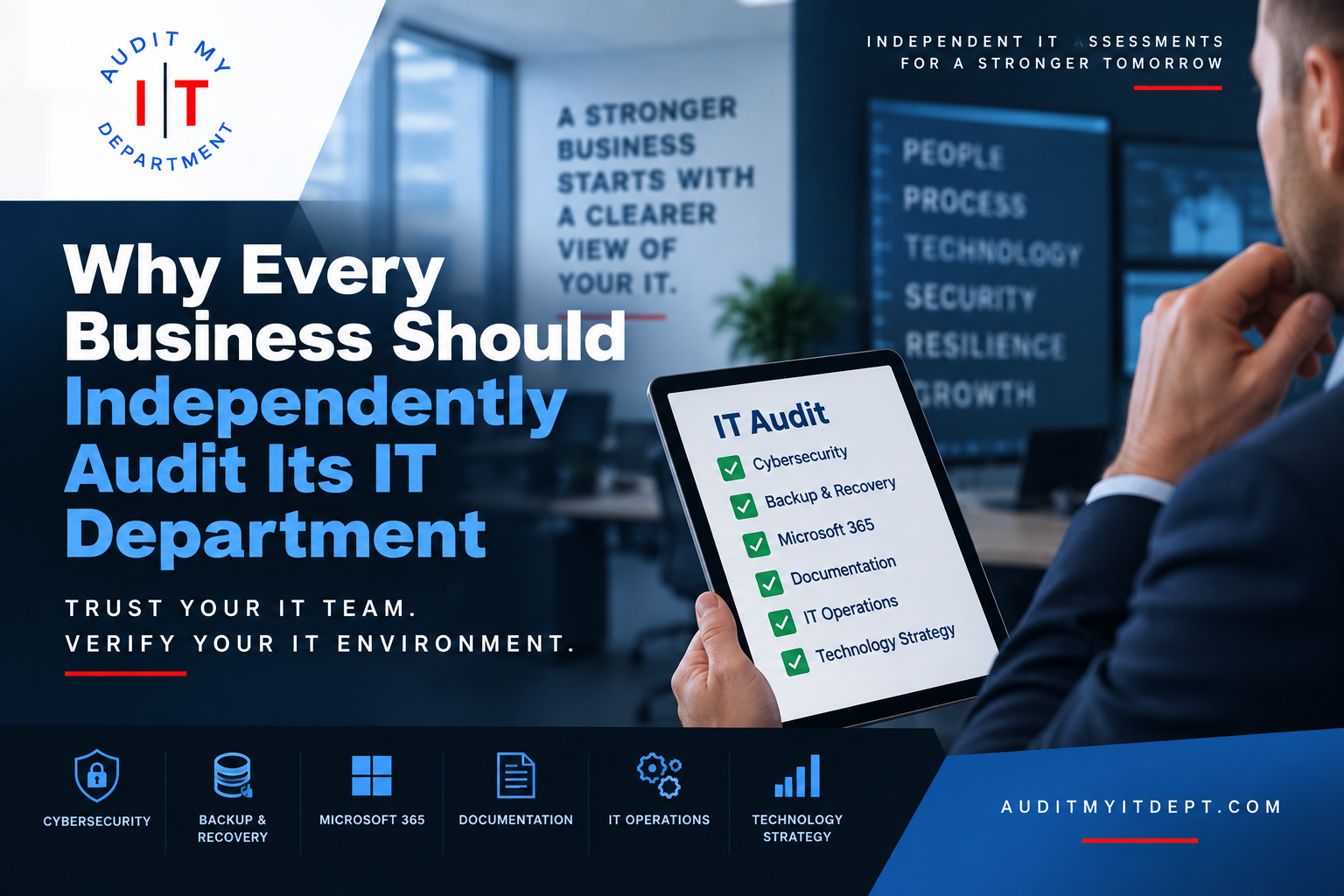
Why Every Business Should Independently Audit Its IT Department
Business owners routinely rely on independent professionals to review critical areas of their organizations.
Financial statements are reviewed. Insurance coverage is evaluated. Contracts are examined. Security procedures are tested. Compliance requirements are verified.
But there is one area that is often accepted largely on trust:
Information technology.
When leadership asks whether backups are working, cybersecurity protections are adequate, systems are properly maintained, or critical technology is documented, the answers usually come from the same people responsible for managing those systems.
That doesn’t mean those answers are wrong.
It means leadership may not have an independent way to verify them.
That is the purpose of an independent IT audit.
Trust Your IT Team. Verify Your IT Environment.
An independent IT audit should not begin with the assumption that your IT department or managed service provider is doing a poor job.
In fact, an audit may demonstrate exactly the opposite.
A capable IT team can benefit from an independent assessment because it validates good practices, identifies areas that need additional resources, and gives leadership a clearer understanding of the work being performed behind the scenes.
The objective isn’t to find someone to blame.
The objective is to answer a much more important question:
How do you know?
Your IT team says your backups are running.
How do you know they can actually be restored?
Your organization has cybersecurity software.
How do you know it is configured correctly and protecting every system it should?
Your Microsoft 365 environment requires multifactor authentication.
How do you know there aren’t exceptions or administrative accounts that create unnecessary risk?
Your MSP performs regular maintenance.
How do you know the services you’re paying for are actually being delivered consistently?
These are reasonable questions for business leadership to ask.
An independent IT audit helps provide the answers.
IT Has Become a Business Risk, Not Just a Technical Function
Technology once occupied a relatively small part of business operations.
Today, nearly every critical function depends on it.
Email, accounting, customer information, file storage, communications, payroll, remote access, banking, applications, security systems, and operational processes may all depend on technology being available and secure.
A serious IT failure can therefore become a serious business failure.
A ransomware incident can stop operations.
A failed backup can turn an outage into permanent data loss.
A compromised Microsoft 365 account can expose sensitive information.
Poor documentation can create enormous problems when an employee or IT provider leaves.
Unsupported equipment can create security and reliability risks.
The question is no longer simply:
“Does our IT work?”
Leadership should also be asking:
“Is our IT secure, recoverable, documented, properly managed, and aligned with the needs of the business?”
What Should an Independent IT Audit Review?
A meaningful IT assessment should examine the environment from several perspectives rather than focusing on a single product or security tool.
Cybersecurity
The assessment should examine the organization’s overall security posture.
This can include areas such as:
- Endpoint protection
- Multifactor authentication
- Administrative privileges
- User account security
- Patch management
- Email security
- Firewall configuration
- Remote access
- Security policies
- Microsoft 365 security controls
The objective is not simply to determine whether security products exist.
The important question is whether the organization’s security controls are properly implemented and consistently managed.
Backup and Disaster Recovery
One of the most dangerous assumptions in IT is:
“The backup says successful, so we’re protected.”
A successful backup job doesn’t necessarily mean the organization can successfully recover from a disaster.
An independent review should look at:
- What is being backed up
- How frequently backups occur
- Where backups are stored
- Whether critical systems are included
- Backup retention
- Off-site or isolated copies
- Recovery procedures
- Restore testing
- Recovery objectives
Leadership should know more than whether a backup system exists.
They should understand:
Can we recover the business if something goes wrong?
Microsoft 365
Microsoft 365 has become one of the most important technology platforms in many organizations.
It can also contain enormous amounts of sensitive business information.
An assessment should examine areas such as:
- Multifactor authentication
- Administrative accounts
- User access
- Email security
- Sharing permissions
- Former employee accounts
- Licensing
- Security configurations
- Data protection
Small configuration mistakes can sometimes create significant exposure.
IT Documentation
Documentation may not seem as urgent as cybersecurity, but poor documentation can become a major operational risk.
Leadership should ask:
If our primary IT person disappeared tomorrow, could someone else manage our environment?
Important documentation may include:
- Network information
- Vendor relationships
- Licensing
- Equipment inventories
- Administrative procedures
- Backup procedures
- Critical applications
- Support contacts
- Technology policies
No organization should be completely dependent on information that exists only in one person’s head.
IT Operations and Support
An IT audit should also examine how technology is managed day to day.
Questions might include:
- Are support requests tracked?
- Are recurring problems identified?
- Are systems proactively monitored?
- Are devices being patched?
- Are new employees properly onboarded?
- Are departing employees promptly disabled?
- Are technology assets tracked?
- Are vendors being managed?
- Are recurring IT issues being addressed strategically?
These operational processes can have a significant impact on productivity and security.
Technology Strategy
Good IT management isn’t only about maintaining what exists today.
Leadership should understand what comes next.
An independent assessment can help determine whether the organization’s technology strategy addresses:
- Aging infrastructure
- Software lifecycle
- Cybersecurity improvements
- Cloud adoption
- Business growth
- Budget planning
- Risk reduction
- Future technology investments
Without planning, technology decisions often become reactive.
And reactive IT is usually more expensive than planned IT.
An Audit Isn’t About Replacing Your IT Department
This point is important.
An independent IT audit does not automatically mean replacing your internal IT staff or managed service provider.
A good assessment can actually make an existing IT team stronger.
Imagine an independent review identifies that the company needs better backup infrastructure, additional security tools, or resources to replace aging equipment.
Your IT team may have been recommending those improvements for months.
The audit gives leadership independent validation that the investment is justified.
Likewise, an assessment may confirm that many areas of the environment are already being managed exceptionally well.
That information has value too.
The goal should be visibility and improvement, not blame.
Independent Verification Creates Accountability
Leadership doesn’t need to understand every technical detail of the IT environment.
But leadership should have enough information to understand the organization’s technology risk.
An independent assessment creates a separation between:
the people managing the environment
and
the people evaluating the environment.
That distinction is common throughout business.
Organizations don’t avoid financial audits because they trust their accounting department.
They don’t stop reviewing insurance because they trust their broker.
Independent verification is simply good governance.
Technology deserves the same consideration.
What Leadership Should Receive From an IT Audit
A useful IT audit shouldn’t end with a massive technical document that only another IT professional can understand.
Leadership should receive clear answers.
At Audit My IT Department, we believe the results should help identify:
What’s working well
Areas where the organization has appropriate controls and good technology practices.
What needs attention
Weaknesses, vulnerabilities, operational concerns, or missing processes.
What presents the greatest risk
Issues that could significantly affect security, operations, recovery, or the business.
What should happen next
A prioritized action plan that separates urgent concerns from longer-term improvements.
The objective is to turn technical findings into business decisions.
When Should a Business Consider an Independent IT Audit?
There doesn’t have to be an emergency.
An assessment can be valuable when:
- Leadership wants an independent second opinion.
- The organization has grown significantly.
- A new IT provider has taken over.
- The company has used the same provider for many years.
- Cyber insurance requirements have changed.
- There have been recurring IT problems.
- A security incident has occurred.
- Leadership is concerned about backups or disaster recovery.
- The organization is preparing for an acquisition or major expansion.
- Key IT personnel are leaving.
- Technology costs are increasing without clear explanation.
- The board or ownership wants greater visibility into technology risk.
And sometimes the reason is much simpler:
Leadership just wants to know where the organization stands.
That’s reason enough.
Don’t Wait for an Incident to Discover the Gaps
The worst time to discover that backups don’t work is during a recovery.
The worst time to discover an undocumented administrator account is after a security incident.
The worst time to discover that nobody knows how a critical system works is after the person managing it leaves.
Independent IT assessments are about discovering those issues before they become business problems.
Your IT department may be doing an excellent job.
Your managed service provider may be delivering exactly what was promised.
Your cybersecurity controls may be properly configured.
Your backups may be completely recoverable.
That’s excellent.
But leadership should be able to verify it.
Trust Your IT Team. Verify Your IT Environment.
An independent IT audit provides business owners and leadership teams with something that’s difficult to obtain from day-to-day IT management:
an objective second opinion.
It provides an opportunity to validate what’s working, uncover hidden risks, establish priorities, and give leadership a clearer picture of the organization’s technology environment.
You don’t have to wait until something goes wrong to ask:
How do we know?
Ready for an Independent View of Your IT?
Do you really know how well your IT environment is performing?
Audit My IT Department provides independent assessments of cybersecurity, backups and disaster recovery, Microsoft 365, IT operations, documentation, infrastructure, and technology strategy.
Find out where your organization is strong, where you’re exposed, and what should be addressed next.
REQUEST AN IT AUDIT
Call: 847-281-5953
AuditMyITDept.com