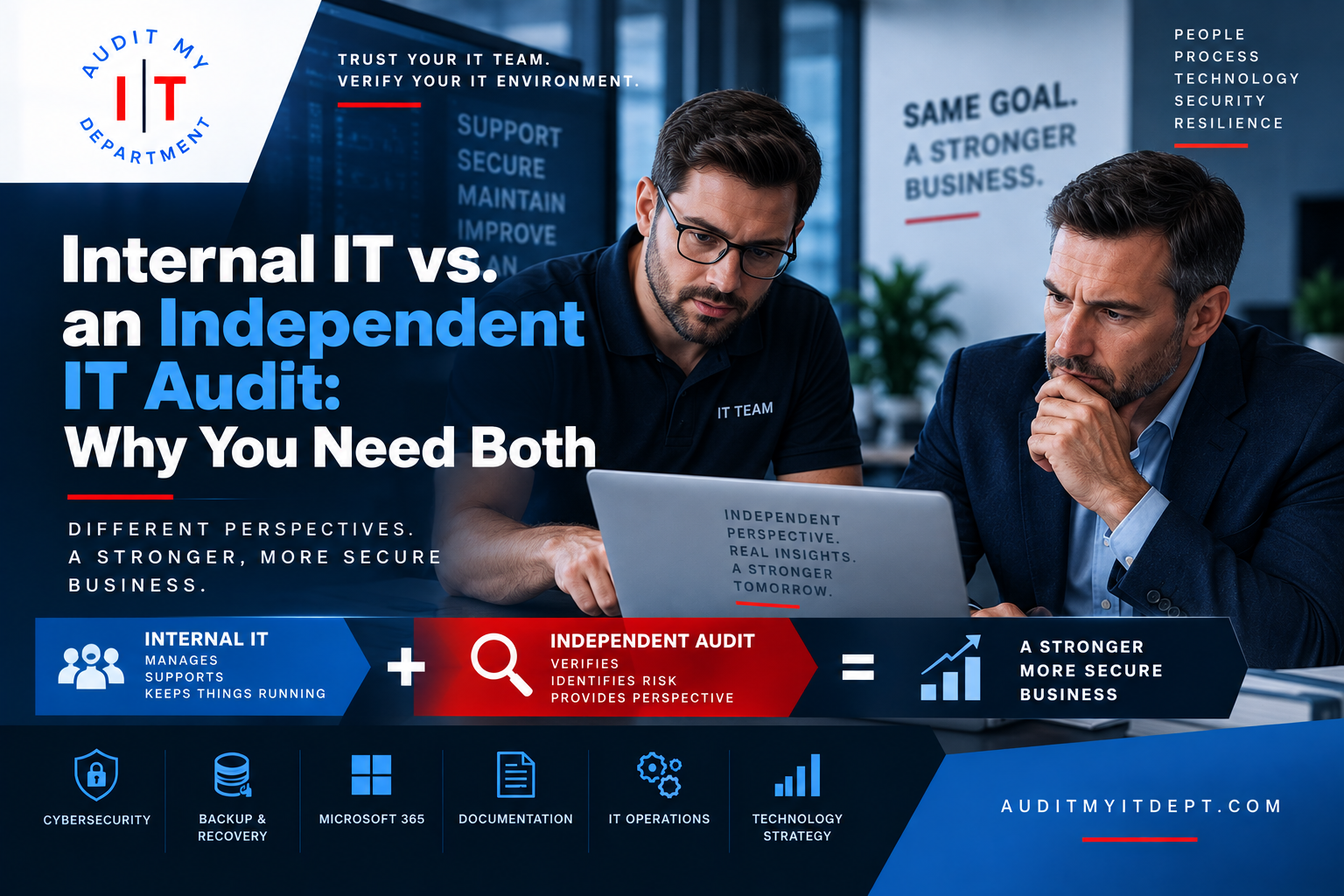
nternal IT vs. an Independent IT Audit: Why You Need Both
If your company already has an experienced IT department, why would you need an independent IT audit?
It’s a reasonable question.
After all, your internal IT professionals know your systems, support your employees, manage your infrastructure, protect your data, and solve technology problems every day.
An independent assessment isn’t intended to replace that expertise.
In many cases, it can actually strengthen it.
The distinction is simple:
Your IT team manages the environment. An independent audit verifies the environment.
Those are two different responsibilities—and a healthy organization can benefit from both.
Your Internal IT Team Has an Important Job
Internal IT professionals are responsible for keeping technology working.
Depending on the organization, their responsibilities may include:
- Supporting employees
- Managing computers and servers
- Maintaining networks
- Administering Microsoft 365
- Managing cybersecurity
- Monitoring backups
- Maintaining business applications
- Managing vendors
- Onboarding and offboarding employees
- Planning technology upgrades
- Responding to security incidents
That’s a significant workload.
Good internal IT teams also develop valuable institutional knowledge. They understand the company’s employees, applications, workflows, vendors, history, and business requirements.
That knowledge is extremely difficult for an outside organization to replicate.
An independent IT audit isn’t intended to eliminate that advantage.
It’s designed to provide something different:
An objective second opinion.
Managing IT and Auditing IT Are Different Functions
Imagine asking:
“Are our backups properly configured?”
Your IT department may answer yes because it configured and monitors the backup system.
That’s useful information.
But an independent auditor approaches the question differently.
The auditor may ask:
- What systems are included?
- What isn’t included?
- Where are the backups stored?
- Who can access them?
- Could ransomware reach them?
- When was the last recovery test?
- How long would recovery take?
- Are recovery procedures documented?
The objective isn’t to contradict your IT team.
It’s to independently verify the result.
This concept isn’t unusual in business.
Accounting departments manage financial information, yet organizations still conduct financial audits.
Employees manage business processes, yet companies perform compliance reviews.
Security teams implement controls, yet penetration tests are conducted by independent professionals.
Independent verification creates another layer of confidence.
IT should be no different.
Even Excellent IT Teams Can Have Blind Spots
Technology environments evolve continuously.
New employees arrive.
Applications are added.
Cloud platforms expand.
Old systems remain in service.
Security requirements change.
Vendors come and go.
Temporary configurations sometimes become permanent.
Over time, even well-managed environments can develop gaps.
An internal team may also become accustomed to the way things have always been done.
An outside reviewer enters without those assumptions.
That fresh perspective can identify issues that have simply become part of the scenery.
Examples might include:
- Legacy administrator accounts
- Outdated equipment
- Inconsistent multifactor authentication
- Incomplete documentation
- Unused software licenses
- Weak backup isolation
- Unsupported operating systems
- Excessive user permissions
- Missing recovery testing
- Processes that depend too heavily on one employee
None of these automatically indicate incompetence.
They often reflect the reality of managing a constantly changing technology environment.
An Audit Can Validate Your IT Team’s Good Work
Independent assessments aren’t only about finding problems.
They can also confirm that your organization is doing things correctly.
Suppose an assessment determines that:
- Multifactor authentication is properly deployed.
- Administrative privileges are tightly controlled.
- Systems are consistently patched.
- Backups are isolated and tested.
- Documentation is current.
- Employee offboarding is properly handled.
- Cybersecurity controls are appropriately configured.
- Infrastructure is being proactively replaced.
- IT operations are well managed.
That’s valuable information for leadership.
It provides independent confirmation that the company’s technology investments and IT personnel are delivering results.
A good audit should recognize strengths as well as weaknesses.
Your IT Team May Already Know What Needs Improvement
This is an important point that executives sometimes overlook.
Your IT department may already know exactly where the organization’s biggest risks are.
The problem may not be technical knowledge.
It may be budget, staffing, time, or executive approval.
For example, IT may have repeatedly recommended:
- Replacing an aging server
- Upgrading a firewall
- Implementing stronger backup protection
- Purchasing additional cybersecurity tools
- Replacing unsupported computers
- Hiring another technician
- Improving documentation
- Deploying security awareness training
Leadership may have delayed those projects because other business priorities came first.
An independent assessment can validate those recommendations.
Suddenly, the conversation changes from:
“IT wants us to spend more money.”
to:
“An independent assessment confirms this represents a business risk.”
That can help good IT departments obtain the resources they need.
Independent Audits Give Leadership a Different View
IT professionals naturally think about technology.
Executives naturally think about business.
An effective independent audit should connect those perspectives.
Instead of telling leadership:
“Your current recovery point objective doesn’t align with the configured retention policy.”
the report should explain:
“A major system failure could result in the loss of approximately one business day of data.”
Instead of:
“Several privileged identities lack conditional access enforcement.”
leadership needs to understand:
“Some high-level administrative accounts do not have the same protections required for other users, increasing the potential impact of an account compromise.”
The technical details still matter.
But leadership needs them translated into business risk and business decisions.
Independence Creates Healthy Accountability
Internal IT departments frequently report to a CFO, COO, CEO, or other executive.
Those executives may not have deep technical backgrounds.
That can make IT performance difficult to evaluate.
Leadership may know:
- Employees are generally satisfied.
- Major systems appear to work.
- IT responds to support requests.
- The technology budget seems reasonable.
But those indicators don’t necessarily reveal what’s happening beneath the surface.
Cybersecurity controls can be weak while everything appears operational.
Backups can be failing while employees continue working normally.
Documentation can be nonexistent without causing immediate problems.
Unsupported equipment can continue functioning for years—until it doesn’t.
An independent assessment provides another source of information.
That’s not distrust.
That’s governance.
What About an Outsourced MSP?
The same principle applies when IT is outsourced to a managed service provider.
A strong MSP can provide excellent technical expertise and support.
But the provider is still evaluating many of the systems and processes it is responsible for managing.
Periodically obtaining an independent perspective can help verify:
- Contracted services are being delivered.
- Security controls are configured appropriately.
- Backups are being monitored.
- Recovery testing occurs.
- Documentation exists.
- Infrastructure recommendations are reasonable.
- Licensing aligns with actual needs.
- Strategic planning is occurring.
Again, an independent audit doesn’t automatically mean changing providers.
It may confirm that the organization has an excellent MSP.
If so, leadership gains confidence in that relationship.
IT Shouldn’t Be Afraid of an Independent Audit
A professional IT team should understand the value of verification.
In fact, strong IT departments may welcome an independent review.
Why?
Because an audit can:
- Validate their work
- Identify issues they haven’t had time to investigate
- Support budget requests
- Strengthen documentation
- Provide additional expertise
- Prioritize projects
- Demonstrate improvements over time
The audit should not be structured as:
“Let’s catch IT doing something wrong.”
It should be:
“Let’s independently determine where we stand.”
That creates a much healthier relationship between leadership, IT, and the auditor.
The Audit Should Be Independent
For an assessment to provide meaningful oversight, the reviewer should be able to objectively evaluate the environment.
Leadership should receive findings that clearly distinguish:
What’s working
What needs improvement
What represents meaningful risk
What should be addressed first
The goal isn’t to manufacture problems to sell products.
The goal is to provide an accurate picture of the organization’s technology health.
That independence is what makes the assessment valuable.
What Should the Audit Examine?
A comprehensive independent IT assessment should look beyond whether employees’ computers work.
Important areas may include:
Cybersecurity
Are appropriate protections implemented and consistently managed?
Backup & Disaster Recovery
Can the organization actually recover its critical systems and information?
Microsoft 365
Are identities, administrative access, email, sharing, and security controls appropriately configured?
IT Operations
Are support, maintenance, onboarding, offboarding, patching, and monitoring handled consistently?
Documentation
Could another qualified IT professional understand and manage the environment?
Network & Infrastructure
Is the organization’s technology reliable, supported, secure, and appropriately designed?
Technology Strategy
Is IT planning ahead, or simply reacting to problems?
Together, these areas provide leadership with a much clearer picture than any single technical report.
Internal IT and Independent Auditing Should Complement Each Other
This shouldn’t be viewed as:
Internal IT versus the auditor.
The better model is:
Internal IT + Independent Verification + Executive Oversight
Each serves a different role.
Internal IT provides operational expertise and institutional knowledge.
The independent auditor provides objective verification and outside perspective.
Leadership uses both sources of information to make better business decisions.
That’s a much stronger structure.
Trust Doesn’t Eliminate the Need for Verification
You can trust your IT manager and still independently verify your cybersecurity.
You can have an excellent MSP and still test your backups.
You can respect your technology team and still evaluate your documentation.
Those ideas aren’t contradictory.
They’re part of responsible business management.
Your IT team shouldn’t have to prove that it is perfect.
No IT environment is perfect.
The objective is to understand the environment well enough to identify risk, establish priorities, and continuously improve.
Trust Your IT Team. Verify Your IT Environment.
An independent IT audit isn’t a vote of no confidence.
It’s a way to give leadership greater confidence.
If your IT department is doing an excellent job, the assessment can validate it.
If there are gaps, the assessment can help identify and prioritize them.
If your IT team needs additional resources, the findings can help justify them.
And if leadership simply wants an independent answer to:
“How are we really doing?”
an IT audit can provide it.
Give Your IT Team—and Your Leadership—an Independent Second Opinion
Audit My IT Department provides independent assessments designed to help business owners and leadership teams understand the health of their technology environments.
We evaluate areas including cybersecurity, backup and disaster recovery, Microsoft 365, IT operations, documentation, network infrastructure, and technology strategy.
Trust your IT team. Verify your IT environment.
REQUEST AN IT AUDIT
847-281-5953
AuditMyITDept.com